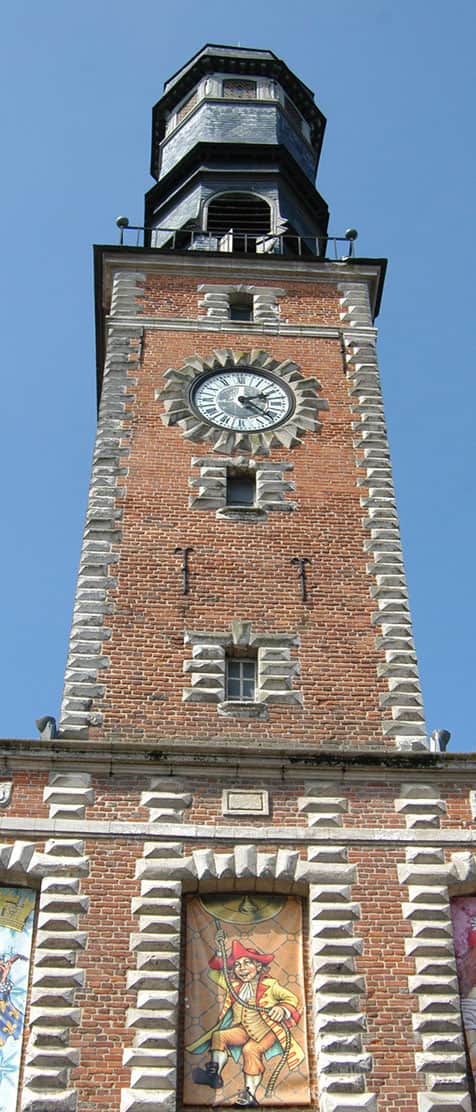
Doullens Belfry
Recognized by UNESCO in 2005 and listed in the Inventory of Historic Monuments in 1966, this belfry was called "the Tower of Beauval" until the 14th century. Seat of the aldermen, this symbol of communal freedoms is typical in the North of France and Belgium. Following numerous invasions, the belfry was destroyed and rebuilt several times. Its last restoration dates back to 1613. This elegant "brick and stone" "bossage" building has received visits from illustrious figures such as Richelieu and the Dauphin Louis XIV.
Rising to a height of 28 meters, the arrangement of white stone and red bricks known as "bossage" was a very fashionable aesthetic trend during the time of Henry IV and Louis XIII. Several peculiarities are worth noting: the belfry does not stand quite in the center of the facade of the town hall and is slightly leaning. In addition, it is crowned by a sentry box covered in slate and of a completely atypical elongated shape.
The interior of the belfry comprises four floors, the ground floor being the most interesting: built entirely of cut stone, it features a large porch and three doors perched on a flight of steps. On the left is the guardhouse, on the right the prison, now occupied by the tourist office, and the central door opens onto a vaulted vestibule magnificently restored in 1970.
The belfry contains three bells, including the famous Jeanne bourdon: in 1653, the Spanish seized it at Auxi-le-Château. The governor of Doullens took it back and, considering it spoils of war, installed it in the belfry. But this bell, cast in 1541, was missing from the Auxilois, and a delegation demanded the return of its bell. The Doullens residents, enamored with it, eventually bought it back, and this is how Jeanne d'Auxi still rings the hours there.
Go to Belfry